
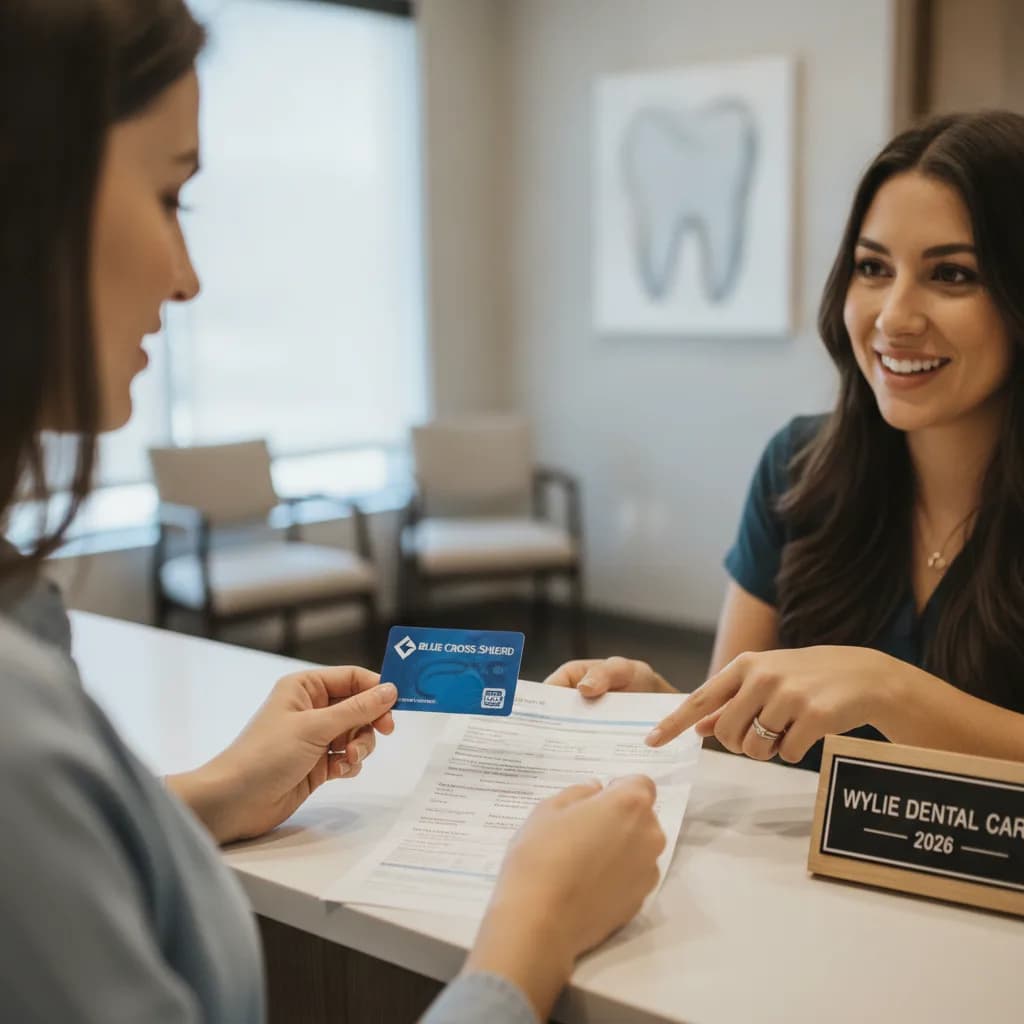
If you're looking for a BCBS dentist in Wylie TX, Willow Family Dentistry accepts Blue Cross Blue Shield of Texas dental plans and files claims on your behalf. Dr. Esther Jeong at Willow Family Dentistry is in-network with BCBSTX PPO dental plans, which means you pay the negotiated in-network rate rather than the full fee, and your out-of-pocket cost is the lowest your plan allows. This guide explains how BCBS dental coverage works at Willow, what your plan typically covers by procedure category, and how to get a pre-treatment estimate so you know your cost before sitting in the chair.
Does Willow Family Dentistry Accept BCBS of Texas?
Yes. Willow is in-network with Blue Cross Blue Shield of Texas PPO dental plans. When you visit Willow as a BCBSTX PPO member, the negotiated fee schedule applies automatically. You pay the in-network copay or coinsurance amount rather than the standard fee. If you carry a different plan, our companion guide on Aetna dental coverage in Wylie walks through the same details for that carrier. The difference between the standard fee and the negotiated rate is written off, meaning you never pay it. According to the ADA, in-network patients save 20-40% compared to out-of-network patients on average because of these negotiated rate reductions.
Important distinction: BCBS offers both PPO and HMO (DentaBlue) plans in Texas. PPO plans allow you to visit any dentist but provide higher benefits at in-network offices. HMO plans require you to visit a designated primary dentist. If your BCBS plan is an HMO, call (972) 881-0715 to confirm Willow is listed as an available provider on your specific HMO network. PPO members can visit Willow without any referral or pre-designation.
What Does BCBS Dental Insurance Cover at Willow?
BCBS dental plans sort procedures into three classes: preventive care is covered at 100%, basic procedures like fillings at around 80%, and major procedures like crowns and molar root canals at about 50%, after any deductible. According to the American Dental Association, this 100/80/50 structure is the most common design in PPO dental plans nationwide. Your share depends mostly on which class a treatment falls into.
BCBS dental plans use the standard 100/80/50 coverage structure that most PPO plans follow. The specifics vary by employer plan, but the framework is consistent across most BCBSTX dental products.
The annual deductible on most BCBSTX dental plans is a relatively small amount per individual. Preventive care is typically exempt from the deductible (you pay nothing for cleanings and exams even before the deductible is met). The annual maximum, the total the plan pays per year, varies by plan and is worth knowing before major treatment. Once the plan has paid that amount in a calendar year, you pay 100% of any remaining treatment. According to the ADA, maximizing your annual benefits before the December 31 reset is one of the most effective ways to reduce dental costs year over year.
Real Cost Examples: What BCBS Patients Pay at Willow
These examples use typical BCBSTX PPO in-network rates. Your actual cost depends on your specific plan's fee schedule, deductible status, and remaining annual maximum.
The "You Pay" column illustrates why in-network matters. An out-of-network provider charges the full standard fee, and BCBS calculates its payment based on the lower "allowed amount" rather than the full fee, leaving you responsible for the difference (called "balance billing"). At an in-network office like Willow, the provider accepts the negotiated rate as payment in full, so there's no balance billing. The in-network savings on a single crown can be significant compared to an out-of-network provider.
Related: Full crown pricing breakdown. → Dental Crown Cost Wylie TX: 2026 Pricing and Insurance Guide
Understanding how BCBS sorts procedures into classes is the key to predicting your costs. Preventive care, cleanings, exams, and x-rays, sits in Class I preventive care and is almost always covered in full, which is why your routine preventive visits typically cost nothing. Basic work like fillings and simple extractions falls into Class II, usually covered at a high percentage after the deductible. More involved work such as crowns, bridges, and molar root canals is Class III, generally covered at about half.
The practical upshot is that your out-of-pocket cost depends far more on which class a procedure falls into than on the office you choose, as long as that office is in-network. Knowing the class of a recommended treatment lets you anticipate roughly what share will be yours before you ever see an estimate.
How Does the Pre-Treatment Estimate Work?
For any treatment beyond a routine cleaning, Dr. Jeong's team submits a pre-treatment estimate (pre-authorization) to BCBS before your appointment. This tells you exactly what BCBS will pay and what your out-of-pocket cost will be before treatment begins. The process takes 5-10 business days for BCBS to process.
The pre-treatment estimate includes the procedure code(s), the negotiated fee for each, the BCBS coverage percentage, any deductible applied, and the remaining annual maximum after this treatment. You receive a printed breakdown showing the plan's payment and your responsibility, line by line. No ambiguity. No checkout surprises.
Dr. Jeong won't proceed with major treatment (crowns, root canals, surgical extractions, implants) until the pre-treatment estimate is back and you've reviewed the numbers. Emergency treatment (pain, swelling, trauma) proceeds immediately with the estimate submitted afterward, because the emergency takes priority over paperwork.
BCBS Plan Details That Affect Your Cost
Three plan details shape what you pay: your annual deductible, your annual maximum (the most the plan pays per year), and whether your provider is in-network. Staying in-network and timing treatment around your maximum are the two simplest ways to lower your out-of-pocket cost. According to the American Dental Association's Health Policy Institute, roughly 77% of Americans have dental benefits, and the large majority of those are PPO-style plans like BCBSTX.
Three plan features that BCBS members should understand before scheduling treatment.
Annual maximum reset. Your BCBS annual maximum resets on January 1 (for calendar-year plans) or your plan anniversary date (for fiscal-year plans). Unused benefits don't roll over. If you have benefit remaining in December and need a crown, scheduling before the annual reset uses coverage that would otherwise disappear. Dr. Jeong's team tracks your remaining maximum and can time treatment to maximize benefit utilization across calendar years. Year-end dental planning guide.
Waiting periods. BCBS plans purchased individually (not through an employer) often impose 6-12 month waiting periods before covering major procedures (crowns, root canals, dentures). Employer-sponsored plans sometimes waive or reduce waiting periods. Verify your waiting period status before scheduling major work.
Frequency limitations. BCBS limits how often they pay for certain procedures: cleanings typically twice per calendar year, x-rays once per 12-36 months depending on type, and crown replacement once per 5-10 years on the same tooth. Dr. Jeong's team checks these limitations when planning your treatment to ensure every claim has the highest chance of approval.
The pre-treatment estimate is the tool that removes the guesswork. Before any major procedure, Willow submits the planned treatment to BCBS, which returns exactly how much it will cover based on your specific plan, deductible status, and remaining annual maximum. You get that number in writing before scheduling, so there are no surprises when the bill arrives.
This matters most for major work, where the difference between plans can be meaningful. Two patients with BCBS coverage can owe different amounts for the same crown depending on their fee schedule and how much of their annual maximum they've already used, which is exactly why a personalized estimate beats any general figure. Staying in-network with a provider like Willow also protects you from balance billing, where an out-of-network office can charge above the insurer's allowed amount and leave you to cover the difference.
What If You Need Treatment That Exceeds Your Annual Maximum?
If a treatment plan is larger than your remaining annual maximum, you have good options rather than a dead end. The most common is to phase the work across two benefit years, completing the most urgent part now and the rest after your maximum resets, so you draw on two years of coverage. For larger restorative plans, our overview of full-mouth reconstruction explains how complex cases are sequenced, and flexible payment options can bridge what insurance does not cover. Willow can also pair your insurance with financing or an HSA for the portion that falls outside coverage, keeping the monthly cost manageable.
When treatment costs more than your remaining annual maximum allows, Dr. Jeong's team presents strategies to minimize your out-of-pocket cost.
Phase treatment across two benefit years. If you need two crowns near year-end, placing one in November (using this year's maximum) and one in January (using next year's fresh maximum). You pay one out-of-pocket amount per crown instead of full price on the second.
Combine dental and medical benefits. Some procedures (TMJ treatment, oral surgery for medical conditions, sleep apnea oral appliances) may be covered under your medical insurance in addition to or instead of dental. Dr. Jeong's team cross-references both benefit plans when applicable.
Use HSA/FSA for the remainder. After BCBS pays its portion, the remaining out-of-pocket amount can be paid with pre-tax HSA or FSA funds, saving an additional 22-37% in federal tax on the out-of-pocket amount.
Finance the patient portion. CareCredit and Sunbit offer 0% interest for 6-12 months on the amount after insurance. A patient portion financed at 0% over 12 months becomes a small monthly payment.
BCBS Member? Let Us Verify Your Benefits.
Call (972) 881-0715 with your BCBS member ID. The team verifies your coverage levels, remaining annual maximum, and any waiting periods in minutes. You'll know exactly what's covered before your first visit.
Finding a BCBS dentist in Wylie TX is the first step. Understanding how to maximize your BCBS benefits is what saves you real money. Willow Family Dentistry is in-network with BCBSTX PPO plans, submits pre-treatment estimates for every major procedure, tracks your annual maximum, and helps you time treatment across benefit years to minimize out-of-pocket cost. Call (972) 881-0715 with your member ID and the team will verify your specific benefits before you schedule.
BCBS Dentist in Wylie, TX, In-Network
Dr. Jeong accepts Blue Cross Blue Shield of Texas. Benefits verified before your visit. Pre-treatment estimates for every major procedure. No surprise bills.
Verify your BCBS coverage in minutes:
BCBS Dentist Wylie TX: HMO vs PPO Coverage Explained
When choosing a BCBS dentist in Wylie TX, the single most important detail is whether you have a BCBSTX PPO or DHMO dental plan, because they work very differently. A PPO plan lets you see in-network providers like Willow with shared-cost coverage by procedure class, while a DHMO plan requires you to use a specifically assigned network dentist and follows a fixed copay schedule.
With a PPO, you have flexibility: you can visit any dentist, but you pay the least when you stay in-network, where negotiated rates and the familiar 100/80/50 coverage structure apply. Willow is in-network with BCBSTX PPO dental plans, so PPO members get those in-network advantages automatically. A DHMO works on a different model entirely, you select or are assigned a primary dental provider, care is generally covered only at that assigned office, and instead of percentage-based coinsurance you pay set copay amounts tied to each procedure. DHMO plans can carry lower monthly premiums, but they trade away the freedom to choose your dentist. The practical takeaway is simple: confirm which type you have before assuming coverage, because a DHMO member must use their assigned office to receive benefits, whereas a PPO member can choose Willow and still receive strong in-network coverage. According to federal coverage guidance, understanding your plan type is the first step to knowing what any dentist will be covered for.
If you are unsure which plan you have, the back of your BCBS card and your benefits summary will indicate PPO or DHMO, and Willow's team can verify your specific plan type and in-network status before your first visit so there are no surprises.
In-Network vs Out-of-Network: Why It Matters for BCBS Members
Staying in-network with your BCBS plan is one of the biggest factors in how much you pay. In-network, a dentist has agreed to BCBS's negotiated fee schedule, so your share is based on those lower rates. Out-of-network, you are typically responsible for a larger portion, and sometimes the difference between the provider's fee and what BCBS allows.
The mechanics are worth understanding because they have a real impact. When Willow is in-network for your BCBSTX PPO plan, the negotiated rate applies, BCBS pays its share by procedure class, and your responsibility is limited to your coinsurance or copay on those agreed rates. Out-of-network, two things change: your coinsurance percentage is often less generous, and you may be billed for the gap between the dentist's standard fee and the amount BCBS recognizes, a gap that does not exist in-network. That combination means the same procedure can leave an out-of-network patient responsible for a noticeably larger share than an in-network patient. This is exactly why confirming in-network status before treatment matters so much, and why Willow verifies your BCBS network status up front. According to the CDC, consistent, affordable access to dental care is closely tied to better oral health outcomes, and staying in-network is one of the most direct ways to keep that care affordable.
For BCBSTX PPO members, the bottom line is that choosing an in-network dentist like Willow is the simplest way to keep your out-of-pocket share as low as your plan allows on every class of treatment.
Common questions
Does Willow Family Dentistry accept BCBS of Texas?
Yes. Willow Family Dentistry in Wylie is in-network with Blue Cross Blue Shield of Texas PPO dental plans. As an in-network office, the negotiated BCBSTX fee schedule applies automatically, so PPO members pay their in-network coinsurance share rather than standard fees on every class of treatment.
What does BCBS dental insurance cover at Willow?
BCBS PPO plans sort treatment into three classes. Preventive care such as cleanings, exams, and x-rays is typically covered at 100%, basic procedures like fillings at around 80%, and major procedures like crowns and molar root canals at about 50%, after any applicable deductible.
How is a routine cleaning covered under BCBS at Willow?
Routine cleanings fall under preventive care, which most BCBS PPO plans cover at 100% when you stay in-network. That generally means little or no patient share for a standard cleaning, exam, and x-rays, though your specific plan and visit frequency limits always apply.
How is a crown covered under BCBS at Willow?
Crowns are classed as a major procedure, which BCBS PPO plans typically cover at around 50% after your deductible, with your remaining share subject to your annual maximum. Willow submits a pre-treatment estimate beforehand so you know your exact coverage and share before the work begins.
Does Willow submit pre-treatment estimates to BCBS?
Yes. For any treatment beyond a routine cleaning, Willow's team submits a pre-treatment estimate to BCBS before your appointment. BCBS returns what it will pay and what your share will be, usually within five to ten business days, so there are no surprises at the visit.
What if my BCBS plan is a DHMO, not a PPO?
A BCBSTX DHMO plan requires you to use a specifically assigned network dentist and pays through fixed copays rather than percentage coverage. Willow is in-network with BCBSTX PPO plans, so confirm your plan type first; the team can verify your network status and benefits before your visit.
How do I verify my BCBS benefits at Willow?
Simply call Willow or share your BCBS member details before your appointment, and the team will verify your plan type, in-network status, deductible, and remaining annual maximum. Confirming these details up front means you walk in knowing exactly what your plan covers and what your share will be.
Did this answer your question?
Written for general reading, not as advice about your own teeth. Nothing here replaces an examination: if something hurts, or has changed, book a visit and let a dentist look at it.

Your first visit
One ticket covers it.
360 Dental · Admit one