
Cosmetic Dentistry
Dental Contouring in Van Nuys: The Smallest Smile Change
Published 12 min read

Dental contouring is the cosmetic treatment nobody markets, because there is very little to market. No porcelain, no lab work, no second appointment. A dentist smooths a fraction of a millimeter of enamel and the edge that bothered you stops bothering you. It sits at the quiet end of cosmetic dentistry at 360 Dental in Van Nuys.
That modesty is the whole appeal, and also the whole limitation. Contouring subtracts. It cannot add length, change color, or move a tooth. Knowing which of those you actually need is most of the decision.
Below is what it fixes, how little enamel is involved, why it cannot be undone, and the cases where something else is the better answer.
What is dental contouring, and what can it fix?
It is the reshaping of outer tooth enamel using fine polishing instruments to even out edges, soften points, and smooth small irregularities. Nothing is added to the tooth. Typical targets are a slightly longer canine, a small chip, or one tooth that reads uneven against its neighbor.
What contouring is usually used for
- Uneven edges across front teeth
- A small chip on an incisor
- A canine that looks slightly pointed
- One tooth overlapping another slightly
- A rough edge you can feel with your tongue
- Edges worn unevenly over time
The effect is subtler than patients expect and more noticeable than they expect at the same time. Nobody will know what changed. Most people simply stop noticing the thing they used to notice, which is usually the goal.
It also helps to know what draws the eye in a smile, because it is rarely the thing patients fixate on. The line the tooth edges make together reads more strongly than any single tooth, which is why evening out three edges can change how a smile looks more than rebuilding one tooth entirely. That is the specific reason a small subtractive procedure can outperform a larger additive one.
Which problems does dental contouring solve best?
Anything that needs a small amount taken away rather than added. Uneven edges, minor points, and slight overlaps respond well. Problems needing length, coverage, color change, or tooth movement do not, no matter how minor they look in the mirror.
| The concern | Is contouring the answer? | Usually better suited to |
|---|---|---|
| Uneven edges across front teeth | Yes, this is the core use | Contouring alone |
| A small chip on one edge | Often yes, if only smoothing is needed | Contouring, or bonding if length is lost |
| Tooth looks too short | No, length cannot be added | Composite bonding or veneers |
| Deep staining that whitening did not lift | No, shape work does not change color | Veneers |
| Noticeably crowded or rotated teeth | No, position is not addressed | Clear aligners |
| A pointed canine | Yes, softening the point is straightforward | Contouring alone |
| Gaps between teeth | No, subtraction widens gaps | Bonding or aligners |
Read the last row twice, because it catches people out. Removing enamel to fix one edge can make an adjacent gap look larger. A dentist is thinking about the whole arch rather than the single tooth you pointed at.
Symmetry is the other thing that gets reassessed. Reshaping one canine often means lightly touching the other so the pair still match, which is a decision worth agreeing before treatment starts rather than discovering halfway through.
How much enamel is actually removed?
A very small amount, usually a fraction of a millimeter, and only from the outer surface. Enamel has no nerve endings, which is why anesthetic is often unnecessary. The limit is set by how much enamel is there to spare in the first place.
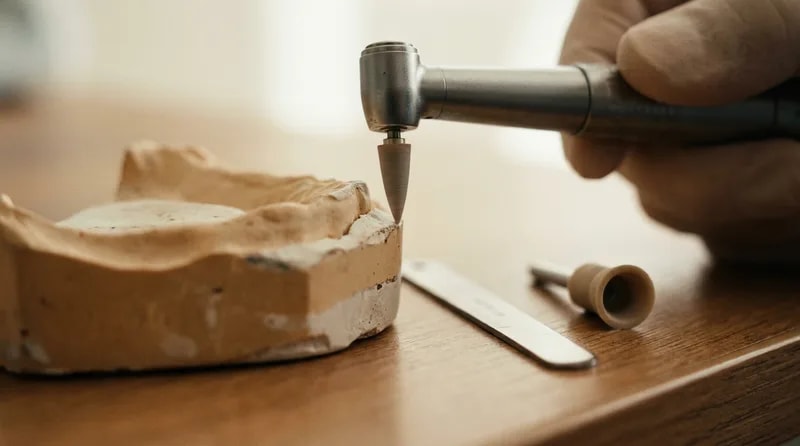
This is where conservative practice matters more than skill with an instrument. Enamel protects the dentin underneath, and thinning it increases the chance of sensitivity. NIH guidance on oral hygiene treats enamel preservation as foundational, and reshaping for appearance is worth doing sparingly for exactly that reason.
How a dentist judges the available margin is worth understanding. Enamel thickness varies across a tooth and between people, it is thinner near the gum line than at the biting edge, and prior wear or a previous reshape reduces what is left. X-rays and the tooth surface itself both inform that call, which is why the answer can differ from one tooth to the next in the same mouth.
If your dentist says the amount needed exceeds what is safe to remove, that is useful information rather than a refusal. It means the problem is a shape problem, and shape problems get solved by adding.
What happens during a dental contouring appointment?
Your dentist reviews the teeth involved, sometimes marks the intended shape, then reshapes with fine polishing instruments and a dental handpiece. The surface is polished smooth afterward. Most cases finish in a single visit, frequently without anesthetic.
Afterward there is very little to manage. No numbness to wait out in most cases, no dietary restrictions, and no settling period. Some people notice a reshaped edge feels unfamiliar to the tongue for a day or two, which passes. Mention any cold sensitivity at your next visit rather than assuming it is the new normal.
Ask to see the result at each pause rather than only at the end. This is one of the few dental procedures where your opinion mid-treatment genuinely changes the outcome.
Where does contouring sit next to bonding and veneers?
Contouring subtracts, bonding adds resin, and veneers cover the front surface with porcelain. They are three different actions rather than three tiers of the same thing. Contouring is the only one that removes tooth structure without replacing it.

Dental contouring
Subtractive, one visit
Removes a fraction of a millimeter of enamel to even edges or soften points. Nothing added, no lab work, usually no anesthetic. The least invasive and least expensive route.
Skip: Anything needing length, coverage, or color change.
Composite bonding
Additive, one visit
Tooth-colored resin is applied and shaped to build up an edge or close a small gap. Adjustable later, and often paired with light contouring on adjacent teeth.
Skip: Extensive shape changes across many teeth.
Porcelain veneers
Covering, multiple visits
Thin porcelain shells cover the front surface, changing shape and color together. ADA patient information on veneers explains the preparation involved, which is more than either option above.
Skip: Cases where a small reshape would have been enough.
Combining them is common and often the most efficient plan. Light contouring on two teeth plus resin on a third can achieve what one patient assumed needed six porcelain veneers. Ask what the minimum intervention would be before discussing the maximum.
| Ask at the consultation | Why it matters |
|---|---|
| How much enamel would come off? | Sets the ceiling on what reshaping can achieve. |
| Is there enough enamel to spare on that tooth? | Thickness varies by tooth and by prior wear. |
| Would bonding get there less invasively? | Adding is reversible in a way subtracting is not. |
| Will the matching tooth need touching too? | Symmetry decisions belong before treatment, not during. |
When is contouring not the right choice?
When enamel is already thin, when the teeth need moving rather than reshaping, when active decay or gum inflammation is present, or when heavy grinding would rapidly undo the result. In those cases reshaping treats appearance while leaving the cause in place.
- Health comes first. Active decay and gum inflammation get treated before any cosmetic work. 42% of adults aged 30 and over have some form of periodontal disease, according to CDC 2024 figures.
- Position before shape. Clear aligners can treat 90% of mild-to-moderate alignment issues according to the American Journal of Orthodontics, so reshaping enamel to disguise position is rarely the better trade.
- Color before shape. Professional teeth whitening can improve shade by 4-8 levels in about 2 weeks according to the ADA, and shape work changes none of that, so settle color first.
- Grinding before edges. If clenching wore those edges down, reshaping without protecting them repeats the problem.
The alignment point deserves emphasis because it is a health argument rather than an aesthetic one. Straight teeth are easier to clean, reducing the risk of cavities and gum disease by up to 30% according to the ADA. If clear aligners would address both the look and the cleaning, that is a better trade than reshaping enamel to fake the result.
Ask for the least invasive option first
A cosmetic consultation at 360 Dental in Van Nuys starts from what is minimum rather than what is maximum, so you can decide from there.
Is dental contouring reversible, and does it need upkeep?
It is not reversible, because enamel does not grow back. It also needs no specific maintenance, since the result is your own tooth structure rather than added material. Normal brushing, cleaning between teeth, and routine checkups are all it asks.
- 99.7%
Of Americans believe a smile is an important social asset.
American Academy of Cosmetic Dentistry
- 10 to 15
Years porcelain veneers can last with proper care.
Journal of Prosthetic Dentistry
- 80%
Of oral health issues can be caught by regular dental visits before they become serious.
ADA
That middle figure is there for contrast. Veneers carry a replacement cycle and a maintenance conversation. Contouring carries neither, which is a real long-term advantage that rarely gets mentioned when patients are shown before-and-after galleries of something more dramatic.
- No replacement cycle, because nothing was placed that can fail or debond.
- No color matching over time, since the surface is your natural enamel.
- Reshaped edges can still chip or wear, exactly as unreshaped ones can.
- Mention any new sensitivity at your next checkup rather than assuming it is permanent.
What should you ask at a cosmetic consultation?
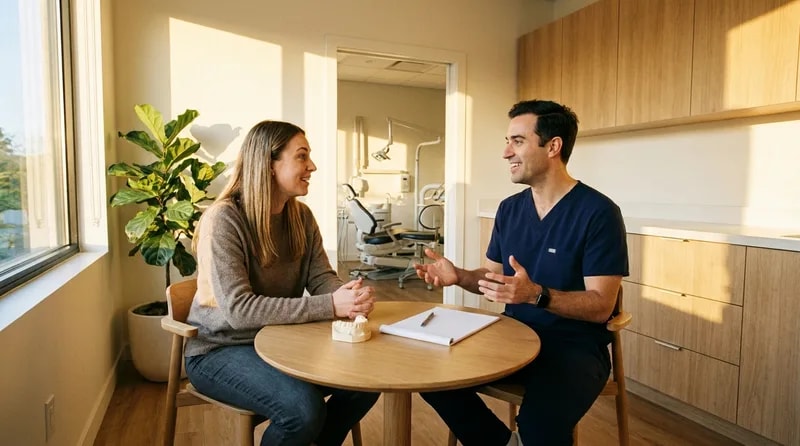
Ask how much enamel would be removed, whether it can be undone, what the result would look like, and whether a less invasive option exists. Then ask what happens if you do nothing. That last question separates a genuine recommendation from a sales pitch.
Questions worth writing down
Check each item you have sorted out in advance.
How much enamel would be removed, and is there enough to spare?
Can any part of this be reversed later?
Would bonding or aligners achieve the same result less invasively?
Should whitening happen before the shape work?
Is my bite or any grinding a factor here?
What happens if I leave it as it is?
Your score: count your checks out of 6.
Be wary of one thing in particular: a consultation that opens with a treatment name rather than a question. The useful version starts by asking what bothers you and works backward to the smallest intervention that fixes it. If the first thing you hear is a package of six veneers, ask what the alternative would be, and ask why it was ruled out.
Bring a photo of your own smile that bothers you, taken in daylight rather than in a bathroom mirror. Patients describe the concern in words like uneven or pointy, which can mean very different things. A photo removes the ambiguity in about five seconds.
The right order of cosmetic treatment
- 1. Treat active disease
- 2. Correct position
- 3. Settle color
- 4. Refine shape
Where can you get dental contouring in Van Nuys?
360 Dental offers cosmetic contouring alongside bonding, veneers, whitening, and clear aligners at 6301 Van Nuys Blvd. Call (818) 787-6400 or request a consultation online, and mention which teeth concern you when you book so time is allowed for the discussion.
Planning your visit at 360 Dental in Van Nuys
- Where
6301 Van Nuys Blvd, Van Nuys, CA 91401, at the corner of Van Nuys Blvd and Victory Blvd, minutes off the 405 and 101.
- Hours
Monday to Thursday, 8:30 AM to 5:30 PM. Friday, 8:30 AM to 4:00 PM. Closed Saturday and Sunday.
- Languages
English, Spanish, and Armenian spoken at the front desk.
- On site
Cosmetic contouring, composite bonding, porcelain veneers, whitening, and clear aligners, plus iTero digital scanning.
- Serving
Van Nuys, Sherman Oaks, North Hollywood, Encino, Panorama City, Valley Glen, Studio City, and Reseda.
- Phone
(818) 787-6400. Rated 4.9 stars on Google with more than 460 Yelp reviews.
One sequencing note if you are considering more than one treatment. Health first, then position, then teeth whitening, then shape. Doing shape work before color means matching any future resin to a shade you may not keep.
Related: Whitening changes shade but not shape, so the order of treatments matters more than most patients expect. Cosmetic dentistry at 360 Dental →
The honest summary of dental contouring is that it is a small procedure with a small ceiling and one permanent consequence. Within that ceiling it is the most conservative cosmetic option available.
Ask how much enamel is involved, settle color and position first, and be suspicious of any plan that reaches for porcelain before it has considered polishing.
Results may vary. Please consult with your dentist at 360 Dental for personalized treatment recommendations.
Find out whether reshaping alone would do it
A cosmetic consultation at 360 Dental in Van Nuys assesses enamel, bite, and shade together, then starts from the least invasive option that works.
Bothered by one uneven edge and unsure it is worth an appointment? Call (818) 787-6400 and ask.
Common questions
What is dental contouring, exactly?
A cosmetic procedure that reshapes the outer enamel of a tooth using fine polishing instruments. Small amounts are smoothed away to even out edges or soften a point. Nothing is bonded on and no material is added to the tooth.
Does dental contouring cause discomfort?
Usually very little, because only the outer enamel layer is involved and enamel contains no nerve endings. Anesthetic is often unnecessary. Tell your dentist if you feel sensitivity, since that can indicate the reshaping is approaching deeper tissue.
Is dental contouring reversible?
No. Enamel does not regenerate, so any amount removed is gone for good. That is why a conservative dentist reshapes less than you might expect and reviews the result before continuing rather than committing all at once.
How long does dental contouring last?
The reshaping itself does not wear off, since it is your own tooth structure. What can change is the surrounding context: neighboring teeth shift, edges wear, and staining develops. Those changes may eventually prompt further work.
Can dental contouring fix crowded teeth?
Only very minor overlaps, and even then it addresses appearance rather than position. Genuine crowding is an alignment problem, and reshaping enamel to disguise it can leave teeth harder to clean. Ask about aligners for anything beyond slight.
Will contouring make my teeth sensitive?
Conservative reshaping of the outer enamel usually does not. Removing more increases the chance of sensitivity, because less enamel sits between the surface and the dentin beneath. This is one reason the amount removed matters so much.
Should I whiten before or after contouring?
Before, in almost every case. Whitening changes shade but not shape, and contouring changes shape but not shade. Getting your color settled first means the final shape decision is made against the smile you will actually keep.
Where can I get dental contouring in Van Nuys?
360 Dental at 6301 Van Nuys Blvd offers cosmetic contouring alongside bonding, veneers, and whitening. Call (818) 787-6400 to book a cosmetic consultation. English, Spanish, and Armenian are spoken at the front desk.
Did this answer your question?
Written for general reading, not as advice about your own teeth. Nothing here replaces an examination: if something hurts, or has changed, book a visit and let a dentist look at it.
Read next
 13 min readVeneers vs Bonding in Van Nuys: Which Fits Your Goal?Veneers vs bonding: a goal-based guide to porcelain veneers and composite bonding, how much enamel each changes, and what to ask in Van Nuys.Read the article
 9 min readIn Office Teeth Whitening vs at Home: Which Lasts?In office teeth whitening vs at home kits: see which actually lasts longer, what each costs, and how to pick the right option for your smile.Read the article
 9 min readSmile Makeover Process: How Dr. Danoukh Plans a CaseSee how Dr. Danoukh maps out the smile makeover process before any work starts, from digital previews to a written treatment plan.Read the article
Your first visit
One ticket covers it.
360 Dental · Admit one