
Pediatric Dentistry
Kids Brushing Routine Morning: What Works on School Days
Published 10 min read
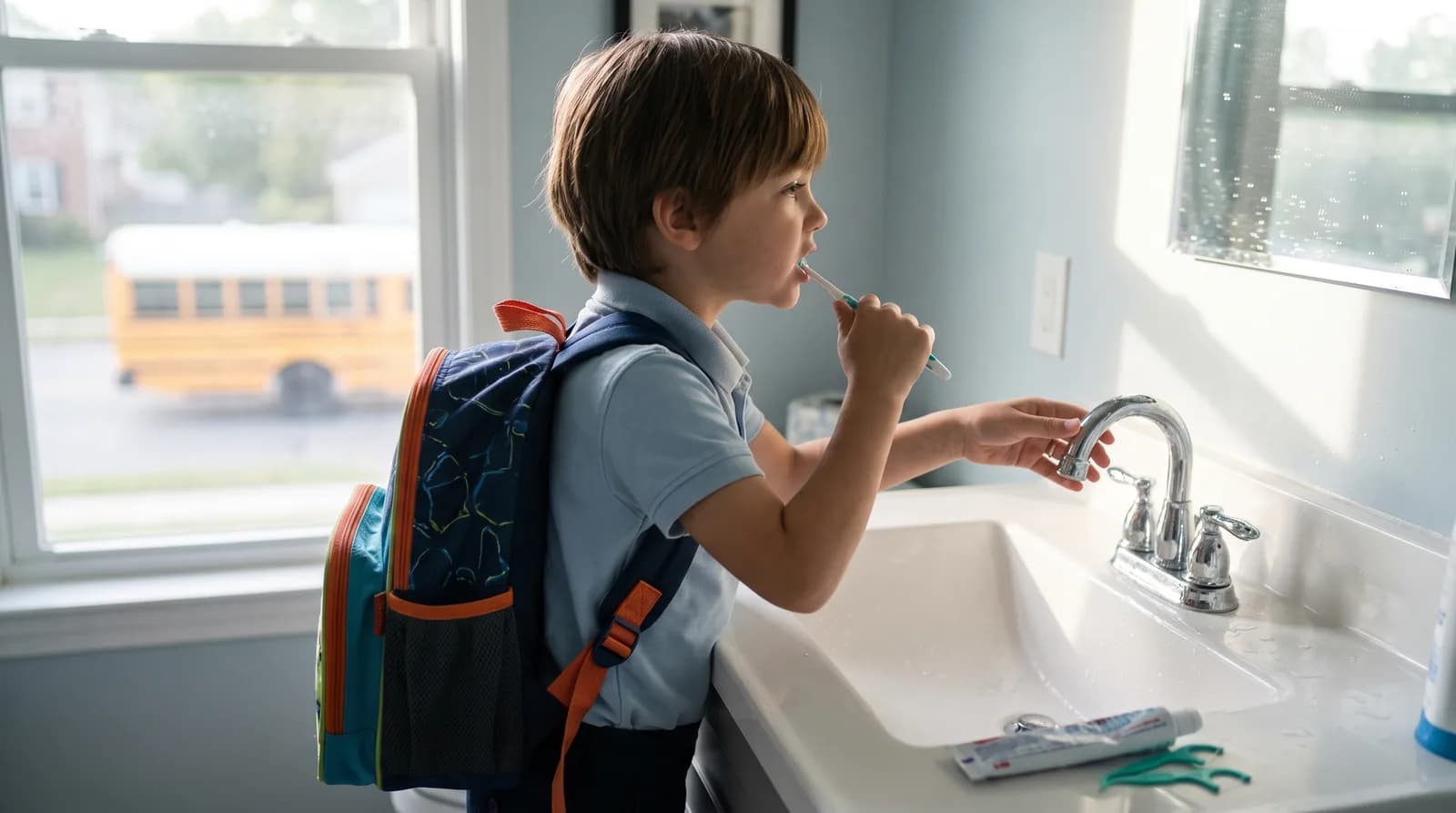
The 7am rush is where most good intentions about pediatric dental care quietly fall apart. Backpacks, shoes, breakfast, and a bus that won't wait leave little room for a proper kids brushing routine morning plan. The good news is a workable routine doesn't need to be elaborate, just realistic.
Most advice about brushing habits assumes a calm, unhurried morning that doesn't actually exist in most households during the school year. A routine that only works in ideal conditions isn't much of a routine at all.
This guide covers how much supervision kids actually need by age, why two minutes feels impossible some mornings, and three routines that hold up on a real school day. For more on building good habits generally, see this practice's pediatric dentistry services.
Kids Brushing Routine Morning: What Actually Works on School Days?
A kids brushing routine morning plan that actually works keeps steps simple, builds in a visual timer, and matches the amount of supervision to a child's actual age rather than assuming full independence too early.
Most failed morning routines try to do too much at once. A realistic version has two or three steps, happens in the same order every day, and doesn't depend on a child remembering something new each morning.
The routine also needs to survive a bad morning, not just a good one. A plan that only works when everyone wakes up on time isn't really a routine. It's a best-case scenario.
According to ADA guidance, consistency in a daily brushing routine matters more than any specific technique or product, especially for younger kids still building the habit.
Age-appropriate expectations matter here too. A routine designed for an 8-year-old rarely works for a 4-year-old, and forcing independence too early usually backfires into more resistance, not less.
The same applies to siblings of different ages sharing a bathroom in the morning. What works for the older child often doesn't translate directly to the younger one, and that's expected rather than a sign something's wrong with either routine.
How Much Supervision Does My Child Need, by Age?
Kids under 6 need a parent to brush their teeth directly or supervise very closely, kids ages 6 to 8 can brush independently with a parent checking in, and kids 8 and older can usually manage the routine on their own.
Fine motor skills needed to brush effectively usually aren't fully developed until around age 6 or 7. Younger kids can hold a toothbrush and go through the motions, but they typically miss spots without direct help.
- Under 6: a parent brushes or closely supervises every session.
- Ages 6 to 8: the child brushes independently with a parent checking in regularly.
- Age 8 and up: most kids can manage the full routine without direct supervision.
These ranges are general guidelines, not hard rules. Some kids need a bit more help a little longer, and that's completely normal rather than a sign of falling behind.
A quick spot-check, even for a child who technically brushes independently, catches missed spots without turning into a full takeover of the routine. It's a light touch rather than hovering over every stroke.
Kids in the 6-to-8 range specifically benefit from a parent occasionally brushing alongside them, not to take over, but to model proper technique without turning it into a formal lesson.
Building Good Habits Early
Regular checkups reinforce good habits at home. Let's get your child on the schedule.
Why Is Getting a Full Two Minutes So Hard?
Getting a full two minutes is hard because it feels much longer to a young child than it actually is, and without a timer or a fun distraction, most kids stop well before the two-minute mark.
Adults underestimate this too. Most people, kids and grown-ups alike, brush for closer to 45 seconds without a visual cue, even when they genuinely believe they hit two minutes.
A phone timer, a two-minute song, or an app made for kids all solve this the same basic way: something external tracks the time so the child doesn't have to guess when to stop.
Two minutes also feels less arbitrary once it's tied to something familiar, like a favorite short song playing through once. That makes the target concrete instead of an abstract number a young child has no real sense of.
Electric toothbrushes with built-in timers solve this same problem automatically, which is worth considering for a child who consistently struggles with the two-minute mark despite other reminders.
Should I Brush Before or After Breakfast?
Brush before breakfast, or wait about 30 minutes after eating if breakfast included juice or another acidic food, since brushing too soon after acid exposure can actually damage temporarily softened enamel.
Acidic foods and drinks, including orange juice and most fruit, briefly soften the outer layer of enamel. Brushing immediately afterward can wear down that softened layer instead of just cleaning the tooth surface.
Brushing first thing, before breakfast even starts, sidesteps this problem entirely and tends to be easier to build into a routine anyway, since it doesn't depend on remembering to circle back after eating.
Rinsing with plain water after an acidic breakfast, even without brushing right away, helps clear some of the acid and makes the eventual brushing session slightly less of a concern if timing doesn't work out perfectly.
This rule matters less for a breakfast without anything particularly acidic, like plain toast or eggs. The 30-minute guideline is specifically about juice, citrus fruit, and similarly acidic items, not every possible breakfast food.
Three Morning Routines That Actually Survive a School Day
Three routines that survive a real school morning are brushing immediately after waking up before anything else starts, using a two-minute song or timer paired with breakfast prep, and a simple visual checklist for older kids to follow independently.
The brush-first routine works well for families where mornings are tightest, since it removes brushing from the post-breakfast scramble entirely. Teeth get brushed the moment a child gets out of bed, before shoes, breakfast, or anything else competes for attention.
The song-or-timer routine works especially well for younger kids who need a concrete reason to keep going. Pairing it with a parent making breakfast in the same room means supervision happens naturally, without carving out separate time.
The checklist routine suits older kids who want some independence but still benefit from a visual reminder. A simple laminated card with three or four steps in order removes the need for a parent to give a verbal reminder every single morning.
None of these three routines are mutually exclusive either. A family might use the brush-first approach on weekdays and a more relaxed version on weekends, adjusting based on what the actual morning looks like that day.
Siblings sometimes do better brushing together rather than separately, turning the routine into a shared moment rather than an individual chore each child resists on their own. This doesn't work for every family, but it's worth trying if one-on-one enforcement has been a struggle.
A Judgment-Free Team for Real Families
Dr. Jeong focuses on what actually works, not perfect routines that don't exist.
What If We're Running Late?
If the morning is running late, brushing should still happen, even if it means a shorter, less thorough session, since a rushed 30-second brush is still meaningfully better than skipping it entirely.
A running-late morning is exactly when a simple, low-effort backup matters most. A pre-agreed shortened version of the routine, even just the front teeth and a quick rinse, beats skipping brushing altogether on a rough day.
Tooth decay remains the most common chronic disease in children, roughly five times more common than asthma, according to the ADA, which is part of why consistency matters more than any single morning being perfect.
20% of children ages 5 to 11 have at least one untreated decayed tooth, according to the CDC. A pattern of mostly-consistent brushing, even with occasional shortened sessions, does more for long-term prevention than a handful of perfect mornings surrounded by skipped days.
Guilt over an occasional missed or rushed session doesn't help anything. What matters is the overall pattern across weeks and months, not any single chaotic Tuesday morning. According to CDC guidance, consistent daily habits over time have a far bigger impact on cavity prevention than any individual brushing session.
How Does Flossing Fit Into a Rushed Morning?
Flossing fits into a rushed morning best as an evening habit instead, since mornings rarely have room for an extra step, and flossing before bed removes food particles that would otherwise sit overnight.
Trying to add flossing to an already tight morning routine tends to make the whole routine less likely to stick. Moving it to bedtime, when there's usually a bit more time, tends to work better for most families.
According to Mayo Clinic's general guidance on dental care, once-daily flossing is sufficient for most people, which means it doesn't need to compete with a rushed morning at all.
For a full walkthrough of proper flossing technique and the most common mistakes, see this practice's guide on how to floss correctly.
What If My Child Resists Brushing?
A child who resists brushing usually responds better to a small amount of choice, like picking the toothbrush or toothpaste flavor, than to arguing over the routine itself every single morning.
Resistance often has less to do with brushing itself and more to do with feeling like everything in the morning is being decided for them. A small, low-stakes choice can defuse that without changing the actual routine at all.
- Let the child choose their toothbrush or toothpaste flavor at the store.
- Keep the same order of steps every morning so it becomes automatic.
- Avoid turning brushing into a negotiation each time; keep the routine consistent.
- Praise the completed routine rather than focusing on technique every morning.
None of this needs to be complicated. A consistent, low-drama routine tends to outperform an elaborate system that requires constant enforcement.
Sticker charts or small rewards work for some families and not others. If one approach isn't landing, switching to a different low-effort strategy is fine. There's no single right way to build this habit.
What matters most is that the routine feels predictable to the child, whatever specific shape it takes. Predictability tends to reduce resistance more effectively than any single trick or reward system on its own. Regular dental visits can catch about 80% of oral health issues before they become serious, according to the ADA, which reinforces why a consistent home routine paired with checkups matters more than any single tactic.
The short version: a workable morning brushing routine is simple, matched to a child's age, and built to survive a bad morning, not just a good one. Brushing before breakfast, or waiting 30 minutes after juice, avoids the acid timing problem entirely.
Results may vary. Please consult with Dr. Jeong for personalized treatment recommendations.
If mornings have felt like a losing battle over brushing, a simpler routine is usually the fix, not more willpower. The goal is a routine that works on a Tuesday when everyone's running ten minutes behind, not just on a calm Sunday morning.
Have a question about your child's routine?
Common questions
What's a good kids brushing routine for morning school days?
Keep it simple: two or three steps in the same order every day. Brush-first, song-and-timer, and checklist routines all work well, and matching supervision to your child's age matters more than the specific method.
How much supervision does my child need while brushing?
Kids under 6 need a parent to brush or closely supervise. Ages 6 to 8 can brush independently with regular check-ins. Most kids age 8 and older can manage the full routine without direct supervision.
Why is it so hard for kids to brush for a full two minutes?
Two minutes feels much longer to a young child than it actually is. Without a timer or song, most people, kids and adults alike, brush for closer to 45 seconds while believing they've hit two minutes.
Should kids brush before or after breakfast?
Brushing before breakfast is simplest. If breakfast included juice or acidic fruit, wait about 30 minutes before brushing, since brushing too soon after acid exposure can wear down temporarily softened enamel.
What should we do if we're running late and can't do the full routine?
A shortened session, even just the front teeth and a quick rinse, is still meaningfully better than skipping brushing entirely. Consistency over time matters more than any single rushed morning.
Should flossing be part of the morning routine?
Flossing generally fits better into an evening routine, since mornings rarely have room for an extra step. Moving it to bedtime tends to make both flossing and the morning routine more sustainable.
Did this answer your question?
Written for general reading, not as advice about your own teeth. Nothing here replaces an examination: if something hurts, or has changed, book a visit and let a dentist look at it.
Read next
 12 min readChoosing a Pediatric Dentist in Wylie, TX: Parent GuideChoosing a pediatric dentist in Wylie?Read the article
 10 min readChild First Dental Visit What to Expect at KindergartenChild first dental visit what to expect: what happens, the language to use at home, the tell-show-do method, and when nitrous oxide helps a nervous child.Read the article
 10 min readSchool Lunch Ideas for Healthy Teeth: A Parent GuideSchool lunch ideas for healthy teeth: why frequency of sugar exposure matters more than quantity, plus an easy swap table and combo ideas.Read the article
Your first visit
One ticket covers it.
360 Dental · Admit one