
Preventive Dentistry
Night Guard for Teeth Grinding: Signs You Need One
Published 13 min read
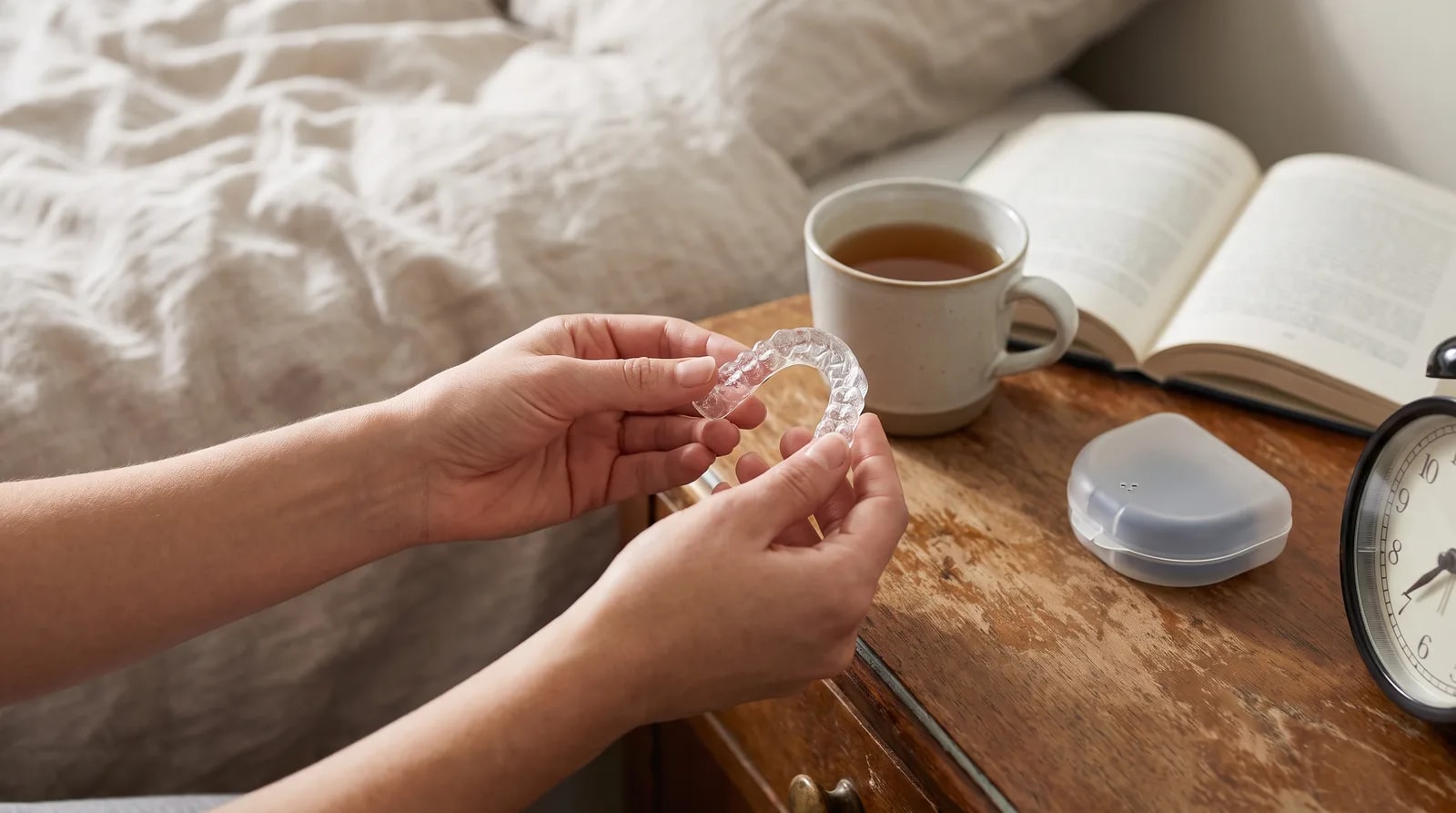
Most people who need a night guard for teeth grinding have no idea they grind. The habit happens while you are asleep, so the first real evidence usually shows up on a dentist's chart: flattened cusps, thinning enamel, a hairline chip on a front tooth. Night guards sit inside general dentistry at 360 Dental in Van Nuys, made from a digital scan.
Here is the part worth knowing early. A guard does not stop you grinding. It absorbs the load so your teeth do not. That distinction changes what you should expect from it, and what else needs looking at.
This guide covers the signs that actually point to grinding, how guard types differ, what an exam checks before anything is recommended, and when a guard is the wrong first step.
What are the signs you grind your teeth at night?
The common signs are morning jaw tightness, tooth sensitivity with no decay to explain it, flattened or chipped tooth edges, and a partner who hears it. Ridged indentations along the inside of your cheek are another clue. None of these are conclusive on their own.
Worth mentioning at your next exam
- Waking with a tight jaw
- Dull tension near the temples in the morning
- Teeth that feel sensitive to cold
- Front teeth that look shorter than they were
- A chipped edge you cannot explain
- Someone hears grinding at night
- Indentations along the inside of the cheek
Notice how many of these are things you would not connect to your teeth. That is the whole problem with self-diagnosis here. ADA patient guidance on teeth grinding makes the same point: the habit is often identified by someone else, or by the wear it leaves behind.
Which is why the timing of your checkup matters more than usual. Regular dental visits can catch 80% of oral health issues before they become serious, according to the ADA, and wear facets are among the earliest things a dentist notices.
There is a distinction worth drawing here. Daytime clenching and nighttime grinding are not the same behavior, and they leave different traces. Clenching while you work tends to produce muscle tightness without much tooth wear, because the jaw is held still. Grinding in your sleep involves side-to-side movement, which is what flattens cusps and polishes enamel into smooth facets. You can have one, the other, or both, and the response differs.
What does a night guard for teeth grinding actually do?
It puts a replaceable layer between your upper and lower teeth so the guard takes the wear instead of your enamel. It also spreads clenching force across more surface area. What it does not do is switch off the habit, which continues underneath the appliance.
That framing matters because expectations drive satisfaction here. Patients who understand they bought protection are happy. Patients who expected the clenching to stop feel let down by a device that was working exactly as intended.
- Protects enamel by absorbing wear that would otherwise flatten cusps and thin biting surfaces.
- Protects restorations including crowns, veneers, and bonded edges, which sit under the same load as natural teeth.
- Spreads force across the arch rather than concentrating it on whichever teeth meet first.
- Gives your dentist data. The wear pattern on the guard shows how hard and where you clench.
That last point is underrated. Bring the guard to every checkup. It is the only physical record of what happens in your mouth overnight, and it often explains why one side of an arch is wearing faster.
How do the different night guard types compare?
Guards differ by how they are made and how thick they are. Custom guards are built from a scan of your own bite. Boil-and-bite versions are shaped at home from a stock tray. Soft, hard, and dual-layer materials suit different clenching intensities and different budgets.
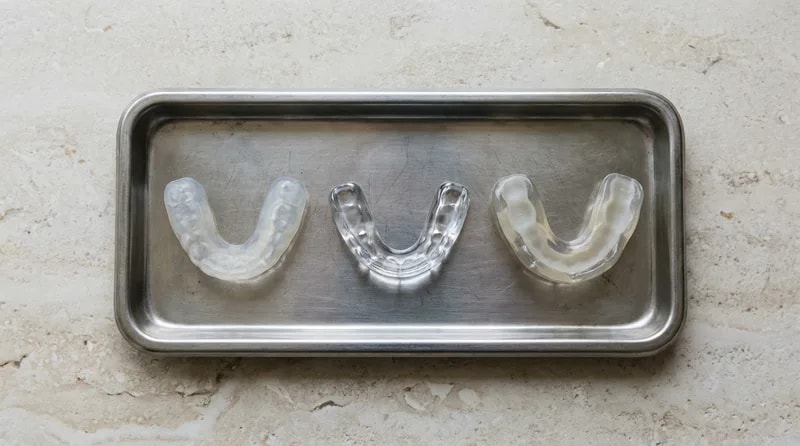
| Type | How it is made | Suits | Trade-off |
|---|---|---|---|
| Custom hard acrylic | Digital scan, made to your bite | Heavy clenchers, protecting restorations | Highest cost, takes a second visit |
| Custom dual-layer | Digital scan, soft inside and hard outside | Moderate to heavy grinding | Costs more than soft, bulkier than thin hard |
| Custom soft | Digital scan, flexible material | Light grinding, first-time wearers | Wears through faster under heavy load |
| Boil-and-bite | Softened at home over a stock tray | Short-term use while you decide | Loose fit, can shift the bite or fall out |
| Stock tray | Ready-made, no shaping | Very little clinically | Poor fit, often abandoned quickly |
| Sports mouthguard | Made for impact, not clenching | Contact sport, not overnight wear | Too bulky and not designed for grinding |
One caution about the sports comparison, because it comes up often. A mouthguard built to absorb a blow to the face is not the same appliance as one built for sustained clenching. Different job, different thickness.
Choosing between the custom options usually comes down to how fast you chew through material. A patient who perforates a soft guard in four months is not a soft-guard candidate, and the guard itself proves it. That is the practical argument for starting with an exam: your existing wear pattern already indicates which material will survive. Guessing means buying twice.
What happens when you get a custom night guard?
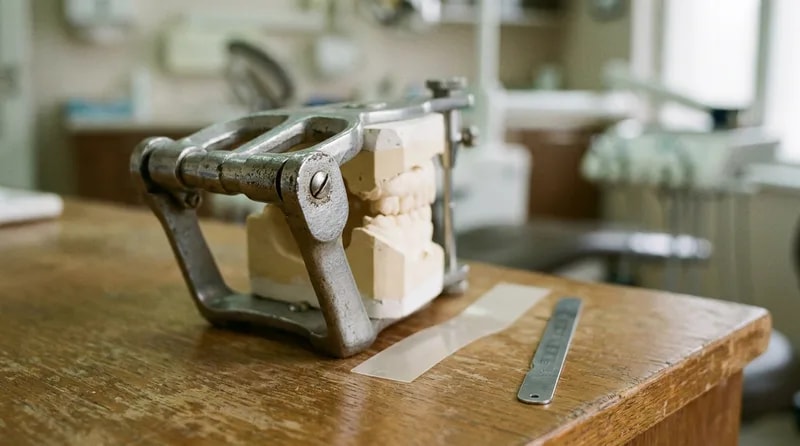
An exam comes first, then a digital scan, then a fitting. At 360 Dental the scan replaces the old impression tray, so there is no putty involved. The guard is made to your bite and adjusted at the fitting visit until it seats comfortably.
Give yourself a couple of weeks to adapt. Sleeping with anything new in your mouth feels strange at first, and most people stop noticing it. If it still feels wrong after that, it needs adjusting rather than enduring.
- Nights 1 to 3First few nights
Expect it to feel bulky and to notice extra saliva. Most people take it out at least once. Put it back in; consecutive nights adapt faster.
- Week 1Settling in
Sleeping through with it in becomes normal for most wearers. Mild morning tenderness that fades within an hour is common.
- Weeks 2 to 4Established
You stop noticing it. If any single tooth still feels like it hits first, call for an adjustment rather than waiting for the next checkup.
What are the most common myths about night guards?
Three misconceptions cause most of the disappointment: that a guard stops grinding, that any guard is as good as another, and that a guard alone addresses jaw tension. Each one leads people to the wrong expectation about a device that does one job well.
- Myth
A night guard will stop me grinding.
- Reality
It protects teeth from the grinding. The habit continues underneath, which is why the cause still needs looking at.
- Myth
A drugstore guard does the same job for less.
- Reality
It offers some protection short term, but a loose fit can shift your bite and often ends up unused in a drawer.
- Myth
If my jaw still feels tight, the guard failed.
- Reality
Tightness has several possible drivers. A guard addresses tooth wear, not the joint or the muscle load itself.
Bring the wear, not just the symptom
If you have chipped an edge or noticed teeth looking shorter, an assessment at 360 Dental in Van Nuys can tell you whether grinding is the cause.
When is a night guard not the right first step?
A guard is the wrong starting point when the real issue is an untreated cavity, a cracked tooth needing restoration, gum disease, or a joint disorder that needs its own assessment. Covering a problem overnight does not address it, and can delay treatment that matters more.
Joint symptoms in particular deserve their own evaluation. The NIH describes TMJ disorders as a group of conditions rather than one problem, which is why clicking, locking, or limited opening should be assessed properly instead of handed an appliance.
This is also why buying one online before an exam tends to backfire. An appliance that covers only some teeth can let the uncovered ones drift, and a guard that seats unevenly concentrates force on whichever tooth touches first. Both problems are quiet. You would not feel either one happening, and by the time you did, the change would already be there.
- Treat what is active. Decay, a cracked tooth, or gum inflammation comes before any appliance.
- Assess the joint if symptoms point there. Clicking, locking, or limited opening belongs in a jaw assessment.
- Protect what is sound. Once the mouth is stable, a guard preserves enamel and restorations.
- Look at the drivers. Sleep quality and stress feed clenching, and neither is solved by plastic.
How does grinding affect crowns, veneers, and fillings?
Restorations carry the same clenching load as natural teeth, and unprotected grinding shortens how long they last. Porcelain can chip at the margins, bonded edges can fracture, and a worn bite changes how the restoration meets its opposing tooth.
The numbers make this concrete. Porcelain veneers can last 10 to 15 years with proper care, according to the Journal of Prosthetic Dentistry, and that phrase does real work: proper care includes protecting them overnight if you clench. Anyone considering porcelain veneers should ask about a guard in the same conversation, not a year later.
- 10 to 15
Years porcelain veneers can last with proper care.
Journal of Prosthetic Dentistry
- 80%
Of oral health issues can be caught by regular dental visits before they become serious.
ADA
- 60%
Lower likelihood of tooth loss among people who visit a dentist regularly.
Journal of Dental Research
Wear also changes how a smile looks, slowly enough that nobody notices in the mirror. Front teeth shorten, edges lose their original contour, and the lower face can appear to close down slightly over years. Patients often bring in an old photo and ask what changed. Grinding is frequently the answer, and it is far easier to protect remaining enamel than to rebuild what has gone.
Related: Protecting cosmetic work overnight is part of planning it, not an afterthought. TMJ and TMD treatment at 360 Dental →
How do you care for a night guard so it lasts?
Rinse it every morning, brush it gently with a soft brush and no abrasive paste, and let it dry fully before it goes back in its case. Keep it away from heat, which warps the material. Never share one with anyone.
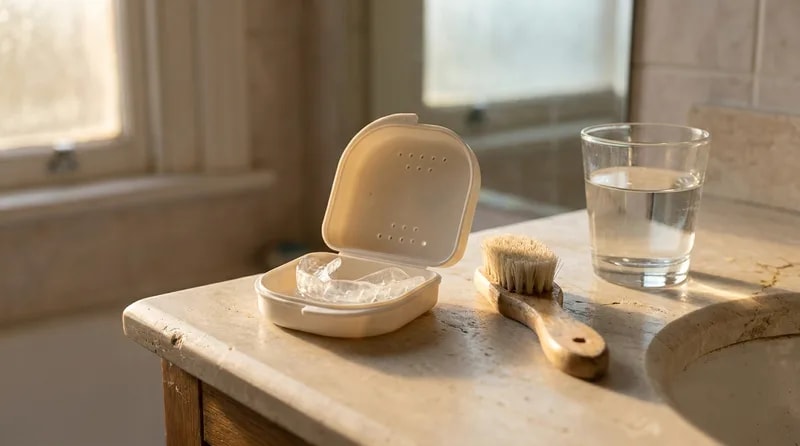
Storage is where most guards die. A damp case in a warm bathroom is the worst combination, and a guard left on a nightstand is a guard a dog will eventually find. That is not a joke; it is one of the most common reasons for a replacement.
Daily and weekly care
Check each item you have sorted out in advance.
I rinse it as soon as I take it out each morning.
I brush it with a soft brush and no abrasive toothpaste.
I let it dry completely before closing the case.
I keep it away from hot water, radiators, and car dashboards.
I bring it to every checkup so the wear can be reviewed.
I store it out of reach of pets.
Your score: count your checks out of 6.
Inspect it monthly. Thinning spots, a perforation, or a change in how it seats all mean it is due for replacement rather than another few months of service.
Flat, polished patches
Side-to-side grinding
Smooth shiny areas on the biting surface point to lateral movement during sleep. This is the pattern that flattens natural cusps fastest.
Skip: Assuming a shiny guard means it is not working.
Deep dents in one spot
Concentrated clenching
Localized indentations suggest force is landing on a few teeth rather than spreading. Worth showing your dentist.
Skip: Trimming or filing it yourself to even it out.
A hole or split edge
Time to replace
Once material is perforated the guard no longer separates the arches at that point. Protection stops there even though the appliance still seats.
Skip: Another few months of use out of habit.
Where can you get a night guard for teeth grinding in Van Nuys?
360 Dental makes custom night guards from digital scans at 6301 Van Nuys Blvd, following an exam of tooth wear and bite. Call (818) 787-6400 or book online. Mention grinding and any morning jaw tightness when you schedule, so the exam covers both.
Planning your visit at 360 Dental in Van Nuys
- Where
6301 Van Nuys Blvd, Van Nuys, CA 91401, at the corner of Van Nuys Blvd and Victory Blvd, minutes off the 405 and 101.
- Hours
Monday to Thursday, 8:30 AM to 5:30 PM. Friday, 8:30 AM to 4:00 PM. Closed Saturday and Sunday.
- Languages
English, Spanish, and Armenian spoken at the front desk.
- On site
Custom night guards from iTero digital scans, 3D CT imaging, plus TMJ and TMD treatment.
- Serving
Van Nuys, Sherman Oaks, North Hollywood, Encino, Panorama City, Valley Glen, Studio City, and Reseda.
- Phone
(818) 787-6400. Rated 4.9 stars on Google with more than 460 Yelp reviews.
One practical note about scheduling. Bring any old guard with you, even a drugstore one. How it has worn tells your dentist more in thirty seconds than a description of your symptoms will.
And if the exam itself is the part putting you off, say so on the phone. 36% of Americans have dental anxiety and 12% have extreme dental fear, according to BMC Oral Health, 2024. A team that knows in advance can pace the appointment differently.
The useful way to think about a night guard for teeth grinding is as a replaceable surface. It wears so your teeth do not, and it needs replacing on a schedule for exactly that reason.
Book an exam before buying anything. Worn enamel, an untreated cavity, and a joint problem look similar from the outside and need completely different responses.
Results may vary. Please consult with your dentist at 360 Dental for personalized treatment recommendations.
Find out whether grinding is wearing your teeth
An exam at 360 Dental in Van Nuys checks wear, bite, and muscle tenderness, then decides whether a custom guard is the right protection for you.
Already have a guard that no longer fits, or waking with a tight jaw? Call (818) 787-6400 and the team will book you an assessment.
Common questions
How do I know if I need a night guard for teeth grinding?
Look for morning jaw tightness, tooth sensitivity without decay, flattened or chipped edges, and a partner who hears grinding. A dentist confirms it by matching wear facets across your bite. Self-diagnosis is unreliable because the habit happens while you are asleep.
Does a night guard stop teeth grinding?
No. It takes the wear instead of your enamel and restorations, but the clenching still happens underneath. That is why an exam looks at what is driving it, including sleep quality and stress, rather than treating the appliance as the whole answer.
Is a custom night guard better than a store-bought one?
Custom guards are made to your bite from a digital scan, so thickness and coverage are controlled. Boil-and-bite versions cost less but fit loosely, which can shift your bite or fall out overnight. Ask your dentist which is appropriate for your wear pattern.
How long does a night guard for teeth grinding last?
Lifespan depends heavily on how hard you clench, so heavy grinders replace guards more often than light ones. Bring yours to checkups so your dentist can see how it is wearing. Visible thinning or perforation means it is time for a new one.
Can grinding damage veneers or crowns?
Yes. Restorations sit under the same load as natural teeth, and unprotected clenching shortens their lifespan. If you have had cosmetic or restorative work done, protecting it overnight is usually part of the maintenance conversation.
Do children grind their teeth too?
Grinding is common in children and often resolves as adult teeth come in, so appliances are less frequently recommended. Mention it at your child's checkup so wear can be tracked. A dentist decides based on the pattern rather than the sound alone.
Will a night guard help jaw tension and headaches?
Some people notice less morning tightness, though results vary and it is not a treatment for joint disorders. A guard protects teeth first. If tension is your main concern, ask for a full jaw assessment rather than an appliance alone.
Does 360 Dental in Van Nuys make custom night guards?
Yes. Night guards are made from digital scans at 360 Dental, 6301 Van Nuys Blvd, following an exam of tooth wear and how your teeth meet. Call (818) 787-6400 to book an assessment.
Did this answer your question?
Written for general reading, not as advice about your own teeth. Nothing here replaces an examination: if something hurts, or has changed, book a visit and let a dentist look at it.

Your first visit
One ticket covers it.
360 Dental · Admit one